Horses: “The hospitality around here is excellent.”

Bridger Foothills Fire forces evacuation of residents

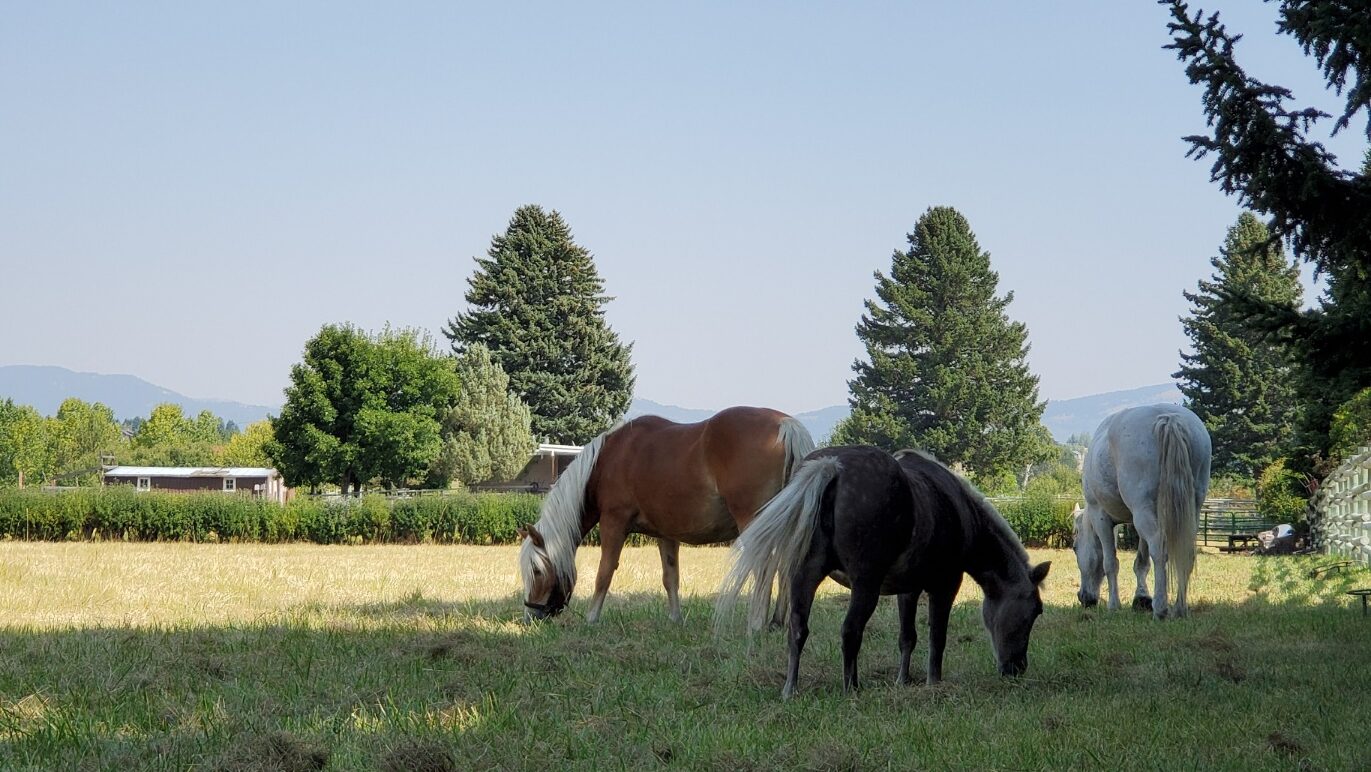
The destruction and displacement caused by the Bridger Foothills fire has been front and center in our town over Labor Day weekend. As Bozeman community members were quickly offering lodging, water, food, and necessities for evacuees, Bozeman Cohousing members Garl Germann and Marci Young recognized our unique capabilities to help four-legged evacuees. The Bridger Canyon area is home to many ranches with horses and cows who needed to be evacuated. Because our site was previously owned by a large animal veterinarian and we have continued to keep grazing animals on the property (our Norwegian Dwarf Goats), we are able to bring other livestock onto our property. Garl and Marci posted several ads offering our space. Late Saturday night, Garl met Tom Fiddaman with his three horses: Daisy, Georgette, and Emmy.

The next day Mary Maj dropped off a stock tank to water the horses. Our fantastic neighbor to the property, Dorothy Dacar, offered her spigot, but couldn’t supply a hose long enough to reach the trough. Cohousing member Karen sent her daughters over with a 100-foot hose and the horses were happily watered 20 minutes later. And to make sure that it wasn’t only our four legged guests taken care of,  Kathleen Owkes coffeed the human evacuees. After three nights our guests, the horses, and their families were able to return to their own home.
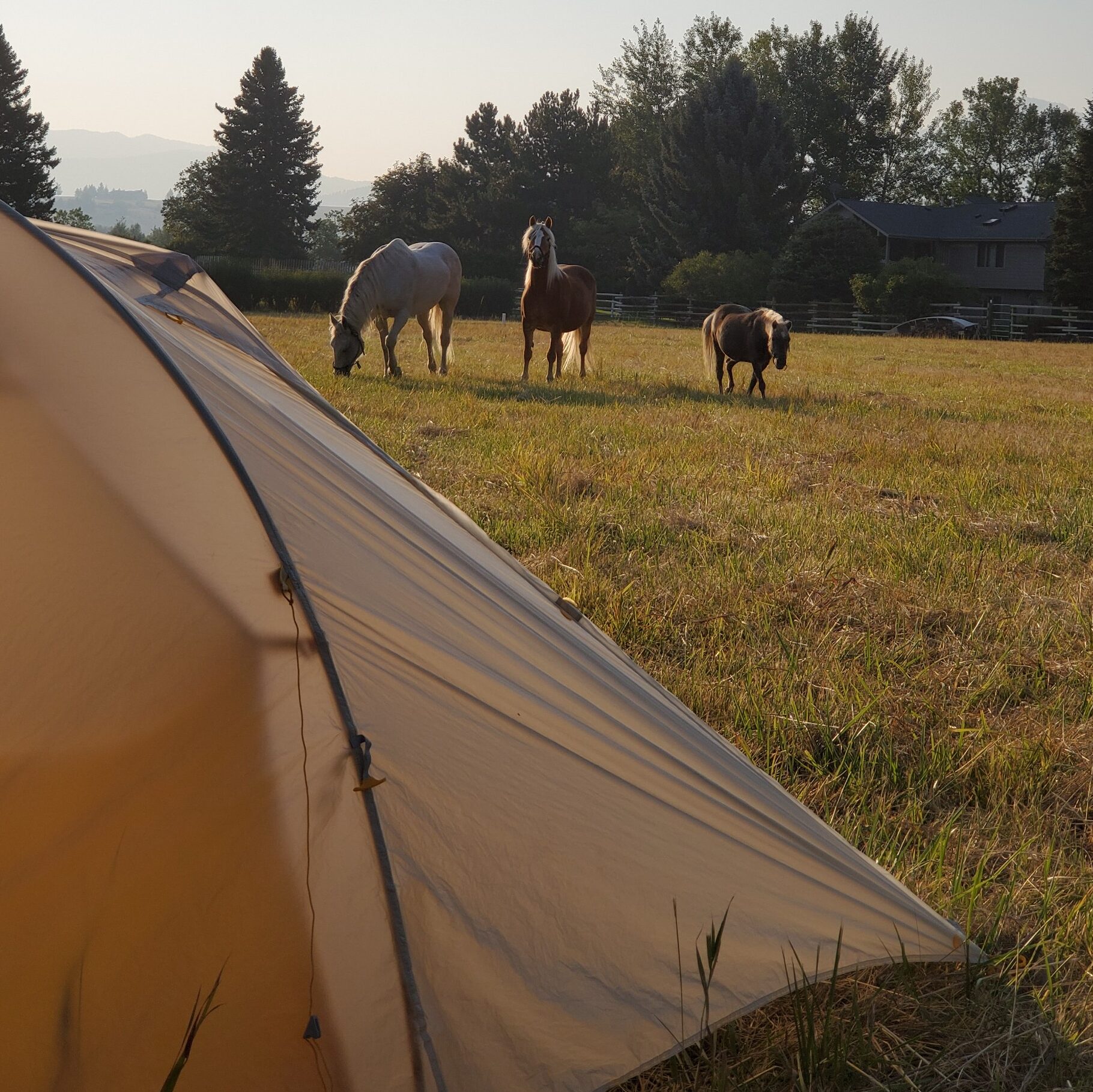
Daisy, Georgette, and Emmy

While it was our desire to help our Bozeman community that we offered our pasture, we did get something out of it, too. I think the most excited people about the horses on the property were our kids. Tom and his family generously introduced each horse to kid members Aurora and Denali. The girls pet and gave haylike pellet treats to Daisy, Georgette, and Emmy. And then, I knew it was coming… The obvious next question from Aurora, “Can we have horses at cohousing?” I’ll leave another member to let her down easy on that one as my constant “No” hasn’t damaged her enthusiasm for the possibility. Or maybe I’ll let her pitch her proposal to the membership for why we should have horses. ;D

We are thankful to be part of a supportive and caring community and are proud to call Bozeman home. We are glad we could do our small part too by sheltering some horses and their humans that needed a temporary home. We were humbled when Tom told us: “The hospitality around here is excellent.”  We hope to always earn that designation from our community.

NBC MT wrote an article about all the helpers in Bozeman, including Bozeman Cohousing members:

https://nbcmontana.com/news/local/bozeman-community-helps-fire-evacuees-animals

Our hearts are with all the people who have lost and to those who fight, including the homeowners who have done what they can to protect their homes, the firefighters, smokejumpers, first responders, coordinators, hand crews, the Sheriff’s department and many others who are tirelessly working to protect our community.

T-minus 3 – 2 – 1 – NET ZERO!

Cohousing’s commitment to energy efficiency and sustainability

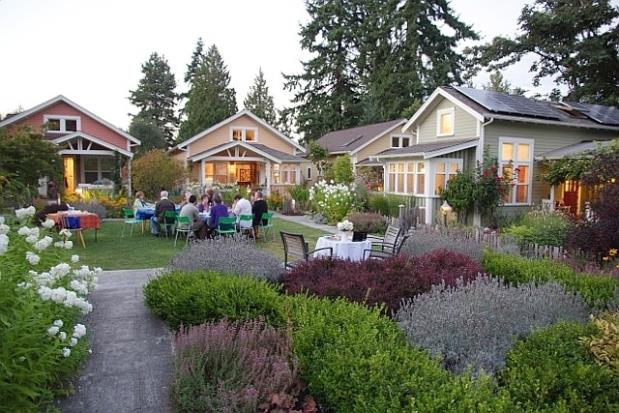
That’s right. Bozeman Cohousing has officially declared net zero carbon intentions. We’ve set aside $400,000 of our budget to equip our whole community with solar panels on homes and/or garages. The exact placement will be determined by comparing sun load at each location. This proposal was approved unanimously.

What does Net Zero mean? 

“Net zero” refers to the balance between carbon emissions produced and carbon emissions taken out of the atmosphere. In order to halt climate change The Paris Agreement sets forth the goal of 1.5 degrees Celsius warming target by mid-century. And to get there the IPCC reports that CO2 emissions must fall to zero. This doesn’t mean that CO2 cannot be emitted ever again, but we must balance our output and our input, and ideally have negative emissions. 

Why did we do it?

Bozeman Cohousing recognizes the reality of climate change and the necessity of humans working together to combat this crisis. Since the industrial revolution, the influence of human activities – primarily burning coal, oil, and gas – have caused excess greenhouse gases to accumulate in the atmosphere, thus amplifying our atmosphere’s natural ‘greenhouse effect’ which warms the earth, the oceans, and increases climate instability (floods, droughts, fires, hurricanes). We’re changing the chemical makeup of our atmosphere and our oceans. This is a global crisis.

Our vision states: “Our community is designed and constructed with an emphasis on sustainability, which our lifestyles reflect.”  We believe that to set our community up for success to achieve the goal of net zero carbon required an adjustment to our budget and designs to include solar arrays from the start.

Our community is designed and constructed with an emphasis on sustainability, which our lifestyles reflect.

–from Bozeman Cohousing Visions Statement

What was our thought process?

Proposal: Include in the budget the cost of sufficient solar photovoltaic arrays (solar panels) to reach the project’s Net Zero Carbon goal.  

Questions raised by the community

  1. How will this impact the cost of homes? 

Studio Co+hab estimated the size of the solar array needed to be ~200kW or about $400,000 total based on Cadius’ Solar Division’s cost of solar installations. This analysis was presented at the Private House Workshop. The cost of the solar installation would be distributed like other construction costs on a per-square-foot basis averaging to about $8,500 to $16,000 per household. (Energy use scales relatively linearly with home size.) There is a 30% federal tax credit available for renewable energy purchases, which is already factored into the price.

  1. How would this impact HOA dues? 

It would lower the cost of occupancy by ~$750 per household per year. That would likely be a reduction in energy bills, rather than a change in HOA dues, however that structure has not been determined at this time. Based on installation costs and avoided energy costs the estimated payback is approximately 13 years. 

  1. How would the systems be owned? 

A: Unknown at this time. There may be an advantage to commercial (HOA) ownership for some or all of the solar. It may also make sense to have the arrays tied to each home at their electrical meters.  In Cadius’ South Rows project, each array is owned by each unit. This is a question that would need to be investigated as a solar array design moves forward.

  1. What are the benefits of doing solar now vs later?

Solar Now

+ Climate change is an immediate issue now, not later
+ We can use being net zero for marketing
+ We get to live our values at move-in
+ Some money may be saved through economies of scale
+ Less hassle, administrative time, and cost doing it during construction
+ The project will have a single array type, so maintenance is simpler/consistent
+ Roof life is extended under solar panels, often more leak-proof fasteners and roof penetrations can be used during initial construction
+ NW Energy is trying to make the net metering agreement far worse; now would likely grandfather the project’s solar metering structure
+ Energy prices may/will likely go up in the future making an investment in solar now increase in value over time
+ Investments in solar can historically be recouped at the time of home sale
+ It will not look hodgepodge
Home prices increase by an average of $10k
Debt buyers have to qualify for a larger loan and pay interest on it

Solar Later

+ Lower initial home prices
+ A homeowner could have more flexibility in the size of array
+ Solar technology is slowly and continuously improving while costs are slowly decreasing over time
+ Perhaps better state or federal solar rebates/tax credits will exist. The opposite is also a possibility. (The current administration has worked to try to end the federal tax credit, though ultimately the authority rests with Congress, which does not appear likely to act on this issue).
+ Solar rental companies may exist in Montana in the future, eliminating the need for large cash outlay
The opposite of most positives in the “now” category

The members discussed the impact of changing tax credit over the next several years and brought up whether purchase would be community-wide vs. individual units. Ownership is still to be determined. 

Decision:  Unanimously approved.

Homes are selling fast. Don’t wait to join!

The progression of a cohousing development is continually moving from the abstract to the concrete.  When Bozeman Cohousing first began in April of 2019, there were only two households, no land, and only a vague vision of what was to come.  As the project has progressed, we secured an amazing 5 acre property only 2 miles from downtown.  We have hired a cohousing consultant, architects, a civil engineer, and a developer.  The site plan has been designed so that we know where the homes and open spaces will be on the property.  We have finalized floor plans for a variety of different sizes and layouts of homes.  As you read this, our architects are now working on the 3D building designs and renderings, which will take the vision out of our heads and on to a piece of paper.  We plan to begin construction in just 9 short months.

Ground level flats are popular for aging in place

Along the way, many new families and individuals have joined to help shape this vision and turn it into a reality.  Over the past few weeks, the number of applicants applying for membership has increased dramatically.  We are starting to have shortages of specific floor plans.  Due to the high demand of 3 bedroom townhouses, we recently voted to switch some of our 2-bedroom townhouses to 3-bedroom townhouses.  We still have a limited number of both of these home types available, but they won’t last long.  Our other most popular home types are the ground level 2-bedroom and 3-bedroom flats, perfect for aging in place or families that want a smaller home but still have access to a private backyard. 

If you have been waiting for the right time to attend a webinar or come to a site tour to learn more about our project, don’t wait any longer.  We currently still have homes available, but they are starting to sell fast.  Haystack Heights cohousing in Spokane, WA recently began construction and set the precedent of having all 39 of their homes pre-sold.  With more people than ever looking for a stronger sense of community and support to help raise their young children or provide stability as they age in place, these homes won’t last long.  Email us today to learn about the homes we still have available.  

Demolitions Begins, With a Little Help from Our Friends

Building healthy communities in Montana

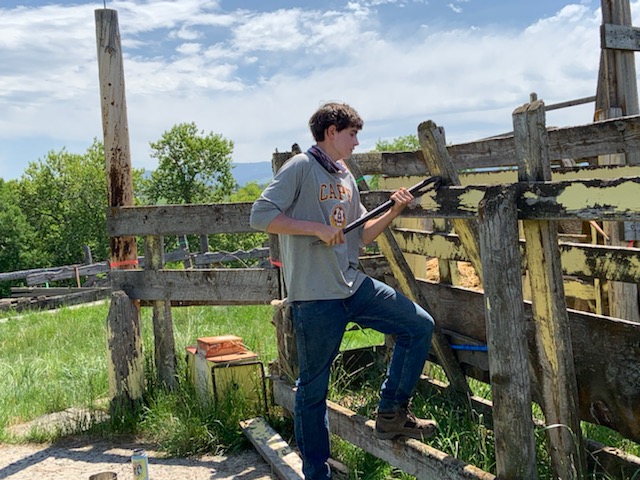
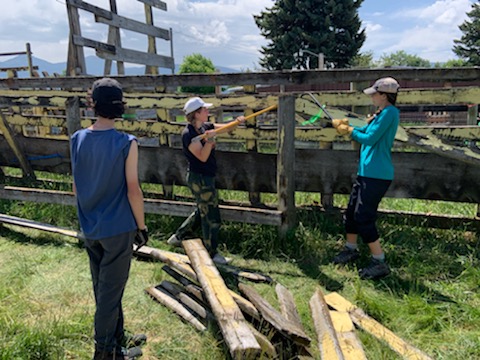
Since Bozeman was first homesteaded, the site of Bozeman Cohousing has been a small farm. A large animal veterinarian and his wife most recently owned this 5.3 acre property where they grazed cattle and horses. As Bozeman Cohousing moves towards development of an intentional community, the tradition of the land will continue to include goats, chickens and shared gardens. The wood from the old fences weathered by years of exposure, will, too. The architects plan to repurpose the materials as part of the common house in our new neighborhood. 

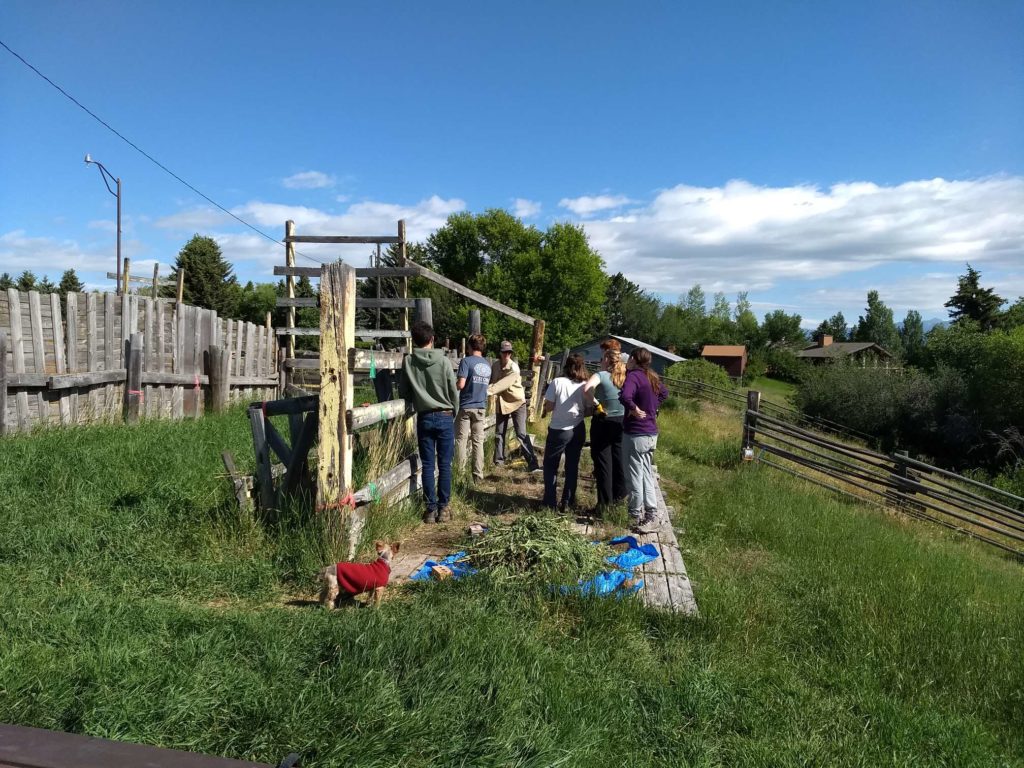
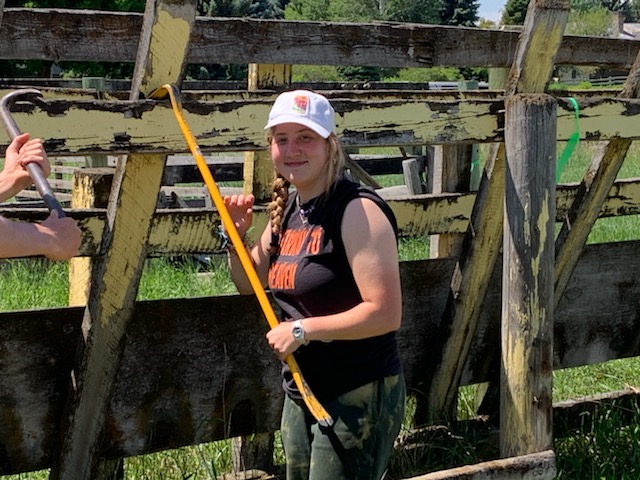
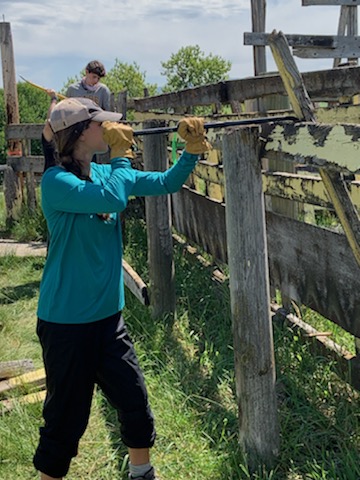
It takes extreme care and time to dismantle the boards so they can be repurposed by removing rusty nails and stripped bolts. Bozeman Cohousing members have been incredibly grateful for the help of teen volunteers who have come to Montana from around the country to learn about sustainable farming and ranching, permaculture, and Western life. Much of the learning includes the hands-on process of volunteer work, and the kids have pitched in to help at the cohousing property removing invasive weeds and carefully taking down old fences. They have also had the opportunity to hang out with the goats on site, watch a milking demonstration, and learn about the philosophies of cohousing.

The teenagers came to Gallatin Valley as part of the organization VISIONS Service Adventures, which normally runs teen programs around the world, but cancelled everything this summer due to the pandemic. VISIONS is now running a singular program here in southwestern Montana, where the home office is also based. They implemented COVID protocols, which means that kids sleep in their own individual tents at a farm outside of town, everyone was tested for the virus, the group was divided into pods, and masks were worn for the first two weeks.

Volunteer work has also taken on a new form for VISIONS, which always focused on construction and labor projects in under-resourced communities around the world. This year the teenagers must be socially distanced from the community, but they’ve nonetheless been able to help with outdoor Food Bank projects, the Learning Garden at Story Mill Park, farming and gardening, and the cohousing site. 

Spontaneity

A Key Ingredient to Meaningful Social Interaction with Your Neighbors

When was the last time you scheduled a dinner out with friends, an afternoon walk, or a zoom call days or weeks in advance only to find that when the appointment came, you were just not in the mood? Or the reverse—have you declined an invitation and then had your schedule open up and wished you had some company? 

Social interaction was not meant to be so scheduled, prescribed and budgeted. Social interaction should happen spontaneously more often than not. We enjoy the most spontaneity with those people to whom we are closest. I never schedule a time to talk to my mom on the phone, I just call her, and if she doesn’t answer or she’s busy, I might call my sister or think of something else to do. My husband and I don’t schedule evenings ahead of time deciding which nights we’ll read after the kids go to bed and which nights we’ll sit and talk about our days or work on a project together. We decide that evening. Sure, we schedule a date night once a month, or more realistically once a year, but our casual regular interactions are unplanned.

And so it could be with more of our relationships if only we lived a bit differently. If your best friend lives down the street, you can pop by her house on your way out for a walk or drop something off and stay to chat for a while. We can see when a neighbor is outside working in their garden and go say hi. If the neighbors are out barbecuing it’s easy to holler an invitation over the fence. In cohousing communities across the country, neighbors gather for meals, bike rides, music, conversation and games, and usually without an appointment. 

Have you always wanted to live next to your best friends and be able to live more spontaneously with them? Now is your chance—call them up and tell them about Bozeman Cohousing!